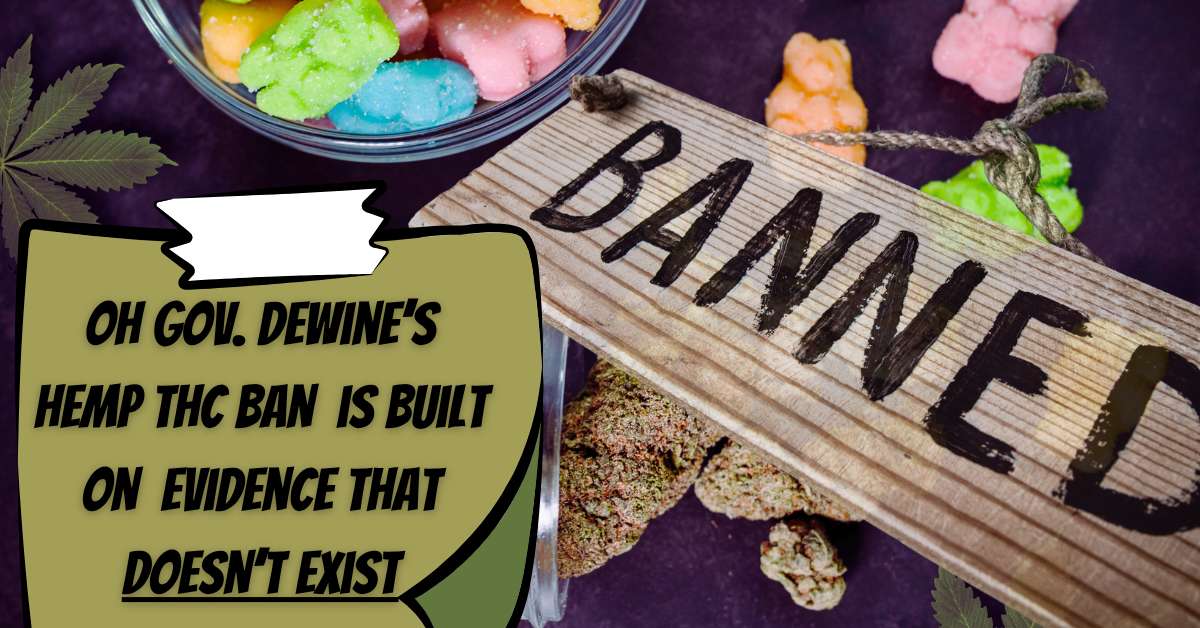
On October 8, 2025, Ohio Governor Mike DeWine issued executive orders to ban the sale of intoxicating hemp products across the state, declaring an “immediate need to address the dangers of intoxicating hemp and its serious threat to public health and safety.”
The ban, which takes effect October 14, gives retailers just days to clear their shelves or face fines of $500 per day.
At his press conference announcing the orders, DeWine held up products like “Stoner Patch Dummies” and “Nerdy Bears”—hemp-infused gummies that parody popular candy brands. “They do it on purpose,” DeWine declared. “They do it to attract kids.”
But when you dig past the soundbites and examine the actual evidence behind Ohio’s sudden hemp crackdown, a different story emerges – one that raises serious questions about policy-making driven by emotion rather than data, and whether this is really about protecting children or rather punishing responsible adult consumers.
The Sting Operation That Wasn’t
During a January 2024 press conference, Governor DeWine claimed that children as young as 12, 13, and 14 years old were able to purchase intoxicating hemp products during a state-conducted sting operation. It’s a damning allegation that would justify immediate action – if the details actually existed.
Here’s the problem… They don’t.
Despite this sting operation being cited as a primary justification for regulatory action, there’s no public documentation detailing:
- How many stores were tested
- What the compliance/failure rates were
- The methodology used
- What specific products were purchased
- Whether retailers asked for ID and were shown fake identification, or simply didn’t card at all
- Any follow-up enforcement actions or citations issued to non-compliant retailers
In fact, the owner of Columbus Botanical Depot publicly challenged DeWine’s claims as false and in my own research wasn’t able to find anything to verify that the sting actually took place other than DeWine’s own word that it happened.
“Anyone that has a store that sells these items isn’t going to risk their license to sell these items to a minor,” Brennan [owner of Columbus Botanical Depot] back in January 2024 when DeWine first started this nonsensical war on hemp products. “That’s just unheard of in this industry.”
When a policy decision affecting thousands of businesses and consumers hinges on an undocumented sting operation with zero transparency, we should all be asking: where’s the proof?
The Real Numbers Tell a Different Story
What we do have is poison control data—and it’s worth examining what it actually shows versus what it’s being used to prove.
According to Ohio Poison Control Center data, exposures to delta-8-THC and delta-9-THC among those 19 or younger increased from 419 in 2021 to 994 in 2024. There were 257 reports of delta-8 poisoning in Ohio in recent years, including 102 in 2023.
Sounds alarming, right? Of course it does – until you put those numbers in a more situational context.
The critical detail that keeps getting buried in the opposition’s argument: more than half of all cases involved children ages five and under. In 2023 alone, 40 cases involved children under six years old.
So, let’s be clear over half – somewhere in the realm of 150 of 257 reports of delta-8 poisoning in OH – were children under five years old.
Let’s be clear about what this means. Five-year-olds aren’t walking into gas stations with their allowance to buy delta-8 gummies. They’re accessing products that adults left within their reach at home.
This isn’t a retail access problem. It’s a storage and parental supervision issue. End of story.
Or at least you’d think so.
The Packaging Problem: Nostalgia or Nefarious Design?
DeWine’s theatrical display of candy-mimicking products is designed to shock –but it ignores a fundamental reality about adult marketing and consumer behavior.
Products like “Stoner Patch Dummies” aren’t targeting children now and never were from the start. It’s like claiming people slip THC candies into Halloween buckets (hello, why would we give away expensive edibles?!).
They’re banking on nostalgia. The adults buying these products grew up eating Sour Patch Kids. They understand the joke. They get the reference. That’s the entire point.
This type of parody packaging has existed in adult novelty products for decades. Walk into any Spencer’s Gifts and you’ll find shot glasses shaped like baby bottles, flasks designed to look like sunscreen bottles, and countless other products that play on familiar brands for adult humor.
We don’t ban IBC Root Beer bottles because a child might confuse their parents’ actual beer for the same thing, do we?. We don’t ban Martinelli’s sparkling cider from being sold in champagne bottles. Hell, we don’t even ban actual alcohol despite children regularly getting into their parents’ liquor cabinets.
The standard we apply to other adult products is simple: parents are responsible for keeping adult items out of reach of children. Why should hemp or cannabis products be held to a different standard?
When the Legislature Fails, Executive Overreach Begins
Perhaps the most troubling aspect of DeWine’s action is the questionable legal authority behind it.
At his January 2024 press conference—the same one where he mentioned the mysterious sting operation—DeWine himself admitted that he needed the legislature to take action to get any significant safeguards into law. The Senate even passed a bill that would have limited intoxicating hemp product sales to licensed dispensaries, but talks broke down between chambers.
Now, months later, DeWine claims his lawyers took “another look” and determined he had the authority all along.
“We believe we have this authority to do this, and I’m not going to sit back and not do it,” DeWine said at the October 8 press conference. “I went back to my lawyers and I said this problem continues to get worse. It is absolutely absurd that a 14-year-old or 13-year-old can walk into the store and buy this stuff.”
That really would be absurd – there’s no evidence of this happening, or of businesses who would readily risk their various licenses to sell regulated products just to sell to minors.
Truthfully, this is where the governor’s argument really falls apart: if the real concern is teenagers purchasing these products, why implement a total ban instead of simply requiring age verification?
You know, like we do for alcohol, tobacco, and even cough syrup.
The Industry Speaks: Regulation, Not Elimination
Even hemp vendors like Jason Friedman, who operates OH CBD Guy, aren’t opposed to reasonable regulation.
Friedman acknowledged the challenges facing the industry: “There are some bad apples out there that are making it more challenging for the rest of us by selling low quality products, by selling it to consumers that are not of age.”
His solution? Not a ban, but sensible guardrails.
“I would be 100 percent in support of regulation to make it official and to give confidence to the state of Ohio that only the right-aged people are going to get these products,” Friedman said.
This echoes what House Minority Leader Dani Isaacsohn articulated: “At a baseline, it shouldn’t be marketed towards children; you should have to be a certain age to buy them; we should know what the ingredients are; they should have to be behind the counter. There are all sorts of ways we regulate beer and wine, we do it a little differently than we do hard liquor, so we certainly should be able to come up with a mechanism for how we regulate intoxicating hemp.”
This is the reasonable middle ground that protects both public safety and consumer access. Age restrictions. Testing requirements. Proper labeling. The same framework we’ve used for literally every other age-restricted product, ever.
Instead, DeWine opted for what Rep. Tex Fischer called “a machete approach” when “this is an issue that needs addressed with a scalpel.” Fischer pointed out that the executive orders put “millions of dollars of products, jobs and small businesses at risk throughout Ohio.”
An industry group has already challenged the ban, citing 20,000 jobs at risk.
The Question Nobody’s Asking
Here’s what’s missing from the entire “protect the children” rhetoric: Where’s the evidence that responsible regulation wouldn’t work?
DeWine’s executive order declares intoxicating hemp products “adulterated” and “dangerous,” requiring all retailers to remove them from shelves by October 14 or face daily fines. This approach completely bypasses more measured solutions like:
- Mandatory age verification (21+)
- Behind-the-counter placement
- Child-resistant packaging requirements
- Restricting sales to licensed retailers
- Regular compliance checks with actual documented results
- Product testing and labeling standards
These are the same safeguards we use for alcohol, tobacco, and now recreational marijuana across the country.. They work. They’re enforceable. They balance public safety with personal freedom.
The Federal Context: A Twisted Interpretation
DeWine’s justification for the ban includes a creative reinterpretation of federal law.
“When hemp was legalized at the federal level as part of the 2018 Farm Bill, Congress did not intend to legalize an unregulated product that could be harmful to children,” he explained.
He went on to say, “when the decision was made by the legislature and by Congress to legalize hemp, it was never a thought that we would see chemists who would change this into intoxicating hemp, which is a totally different product… Because hemp was modified to create intoxicating hemp, intoxicating hemp is simply no longer hemp.”
It’s these semantics that allows DeWine to claim that his order gives the Ohio Department of Agriculture the ability to exclude intoxicating hemp from the definition of legal hemp in Ohio. “When this order goes into effect on Tuesday, intoxicating hemp products will be illegal under the administrative law,” he declared.
But the reality is simpler: the 2018 Farm Bill created an unintended regulatory gap. Instead of filling that gap with sensible regulations, Ohio is choosing prohibition.
The Real Danger: Policy Without Evidence
The most concerning aspect of Ohio’s hemp ban isn’t the policy itself – it’s the precedent it sets.
When governors can implement sweeping bans based on vague claims from undocumented sting operations, conflating accidental poisonings with teen access to justify eliminating an entire product category, we’ve abandoned evidence-based policy-making for political theater.
If a five-year-old gets into their parent’s Stoner Patch Dummies, that’s tragic—and it’s also exactly the same as if they got into their parent’s regular edibles from a dispensary, prescription medications, or hell, household cleaning supplies.
The solution isn’t banning the product. It’s child-resistant packaging and most importantly, parental responsibility.
If teenagers are purchasing these products without age verification, the solution isn’t a total ban – it’s enforcing age restrictions the way we do with every other age-restricted product, and actually documenting compliance rates so we know what we’re dealing with.
Because right now, we have a Governor claiming it’s happening with not a single statistic to tell us at what rate, to what age groups, are they asking for ID at all or did the teens have fakes? All this information matters when coming up with a solution but I can tell you the solution isn’t a ban on legal hemp (or keeping cannabis illegal for that matter).
You know why? The same reason most of Michigan’s dispensaries are expecting a drop in sales once prices rise in January when the new 24% tax is supposed to go into effect – the black market still exists, and people have absolutely no problem going back to it if they have to.
Drug dealers don’t care how old you are. They won’t ask for ID. They also don’t test for pesticides, provide a cannabinoid and terpene profile, or pay taxes.
DeWine’s own words reveal the disconnect: “It is absolutely absurd that a 14-year-old or 13-year-old can walk into the store and buy this stuff. It’s never what anybody intended when the hemp law was passed.”
He’s right. It wasn’t intended. Because there were no age restrictions set by the 2018 Farm Bill. Once again, the absence of regulation created the problem – but the solution is still regulation, not prohibition.
The Bottom Line
Ohio’s hemp THC ban is being sold as a child safety measure, but it’s built on a foundation of missing evidence, conflated statistics, and rejected middle-ground solutions.
When we examine what we actually know:
- Young children (under 6) are accessing products at home, not purchasing them at retail
- There’s no documented evidence of widespread sales to minors beyond the governor’s unsupported claims
- The legislature has proposed reasonable regulatory frameworks that were ignored in favor of executive action
- Industry stakeholders themselves support regulation over elimination
- Packaging that appeals to adults is being characterized as deliberately targeting children
The “protect the children” rhetoric sounds compelling until you realize it’s being used to justify eliminating adult access to legal products rather than implementing the age restrictions and safety measures that actually protect children.
As DeWine stated, “Intoxicating hemp is dangerous and we need better to protect our children.”
But “better” doesn’t mean banning products many adults use responsibly. It means creating a regulatory framework that prevents access by minors while preserving legal adult access – exactly what responsible hemp vendors like Jason Friedman are asking for.
Oh, and the evidence for what you’re claiming needs to actually exist – especially when you’re putting 20,000 jobs and millions of dollars in legal commerce at risk.
Want more stories like this one? Don’t forget to subscribe so you get updates about new content – and if you’re interested in supporting All Things Cannabis, independent journalism, and advocacy efforts, visit our Ko-Fi pageOor our shop!