Only Hours Passed Between Gov. Whitmer’s Signature and Industry Pushback.
When Michigan Governor Gretchen Whitmer signed a new 24% wholesale tax on cannabis into law on Tuesday, the ink barely had time to dry before the Michigan Cannabis Industry Association (MiCIA) filed a lawsuit challenging its legality.
The timing? Just hours after the governor made it official.
This isn’t just industry players being salty about higher taxes. MiCIA is making a constitutional argument that could determine the fate of Michigan’s cannabis market — and possibly even set a precedent for how states can tax voter-approved industries.
MiCIA Sues the State of Michigan to Block 24% Excise Tax on Cannabis
The Michigan Cannabis Industry Association wasted no time taking the state to court, filing their lawsuit in the Court of Claims seeking to completely block implementation of the new tax before it takes effect on January 1, 2026.
The industry advocacy group isn’t pulling punches, either. In their statement, MiCIA called the tax ” Unconstitutional in multiple respects” and their attorney Doug Mains slammed the “last-minute, late-night process” that pushed the measure through.
The Industry Advocacy Group Claims the Michigan Cannabis Tax Was Enacted Unconstitutionally
Here’s where things start to get interesting from a legal standpoint. MiCIA’s lawsuit zeroed in on Article 2, Section 9 of the Michigan Constitution, which requires a three-fourths vote to amend any law enacted by citizen initiative.
Remember, Michigan voters legalized recreational cannabis with the Michigan Regulation and Taxation of Marijuana Act on the 2018 election ballot. That means it’s protected by some serious constitutional guardrails that are clearly being ignored possibly because they didn’t expect to be called out for it.
The new tax passed the Senate 19-17 and the House 78-21 — both well short of the three-fourths threshold needed to amend voter-approved laws. The state tried to get around this by calling it the “Comprehensive Road Funding Tax Act” rather than directly amending the original legalization statute, but MiCIA’s lawyers aren’t buying it.
“Legislative authority over marihuana excise taxes is exclusive to [the legalization law],” their lawsuit argues. “Additional excise taxes require a direct amendment to [the legalization law] itself.”
The association is asking the court to strike the tax entirely, and the state has just under one month to respond.
24% Puts Michigan’s Cannabis Tax Among the Highest in U.S. Legal Markets
Let’s talk numbers here for just a minute – not my favorite thing but necessary from time to time, especially in situations like this. The new 24% wholesale tax applies to sales between growers and dispensaries, in addition to the existing taxes that consumers already pay at the register.
When combined with Michigan’s existing 10% excise tax and 6% sales tax, the new 24% wholesale tax would create a total tax burden of 40% – surpassing Washington State’s 37% retail excise tax, currently the highest in the nation.
Obviously having the highest tax on cannabis isn’t something any state wants to be known for when they know they’re still competing against an established illicit market that pays zero taxes (and follows zero regulations).
The legislature’s fiscal agencies estimate this wholesale tax will generate $420 million annually for road funding. But opponents say that this number is wildly optimistic because it doesn’t account for the drop in sales that will inevitably happen when dispensary prices increase to compensate.
The Michigan Senate Fiscal Agency is a bit more realistic, projecting a 14.4% drop in sales. When you raise prices, people buy less. Economics 101. These business owners won’t have a choice but to raise their prices – or else eat the 24% tax themselves, which is not only unfair but likely impossible considering the exorbitant rate that the legal industry is taxed by the federal government just for being in business.
Governor Whitmer Believes the Tax Will Fund Necessary Roadwork
To be fair to the governor, Michigan’s roads are legitimately terrible. The state ranks 40th nationally for road conditions, and the freeze-thaw cycle does a number on infrastructure every single year.
Whitmer has been trying to fix Michigan’s roads since taking office. Her first attempt — a 45-cents-per-gallon gas tax increase in 2019 — crashed and burned with pushback from both parties. She pivoted to a $3.5 billion bonding program in 2020, but that didn’t extend to local roads and the borrowing authority expires this year.
This new tax is central to her $1.8 billion road-funding plan and was a key piece of the bipartisan budget compromise that nearly triggered a government shutdown when lawmakers missed their October 1st deadline.
In a video statement, Whitmer said: “When I took office, I made a promise to fix the damn roads so Michiganders could get where they’re going faster and safer.”
She’s not wrong about the need. But cannabis industry advocates and business owners argue there had to be a better way than putting the burden on a single industry — especially one that’s already struggling with oversupply and market saturation.
Here’s the thing though – according to The Motley Fool, Michigan is already putting 35% of their existing cannabis tax revenue is allocated to the Michigan Transportation Fund.
According to Michigan.gov Cannabis Taxes Already Contributes Millions to Michigan Roads
The Michigan Transportation (MTF) fund specifically exists to provide funds for roads, bridges, public transportation, railway transportation, aeronautics (airports), non-motorized transportation, and administrative fees related to these sectors of the Department of Transportation.
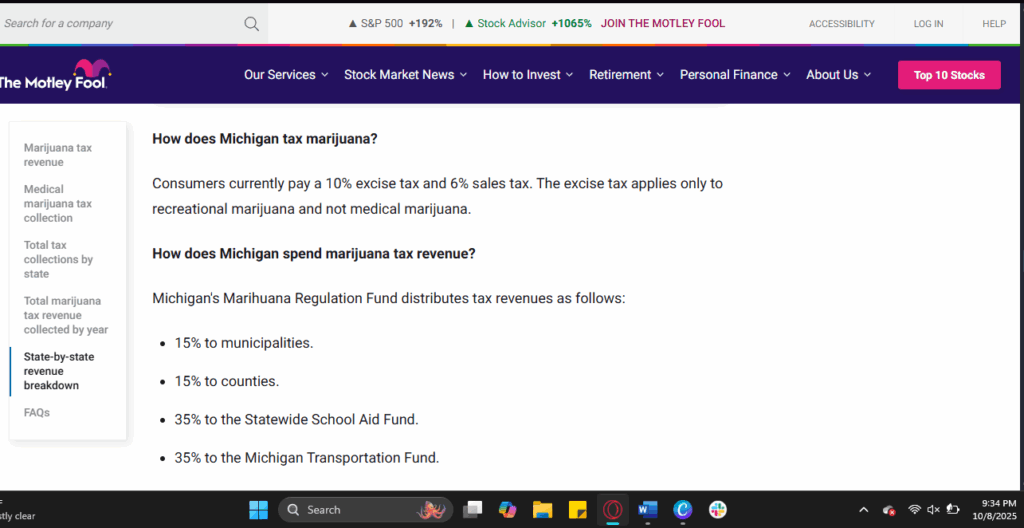
If you Google search “What does the Michigan Transportation Fund cover?” the AI overview even notes that “the MTF is the main source of funding for maintaining and improving state and local roads and bridges.”
Digging a little further, the MTF annual reports show that cannabis has already contributed millions to fix roads across the state. Below are screenshots showing the actual dollar amounts that 35% of the current tax rate is providing for the state.
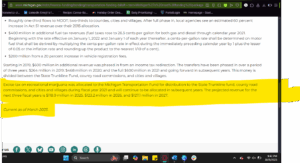
When you look at the year-over-year growth and the projections for the next few years, they’re already looking at adding $300-400 million from cannabis tax revenue. Adding an additional 24% onto this seems not only excessive, but greedy.
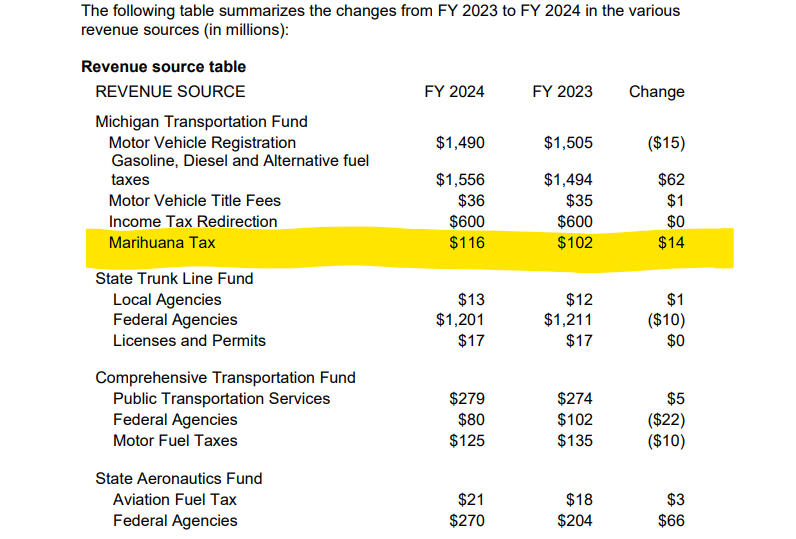
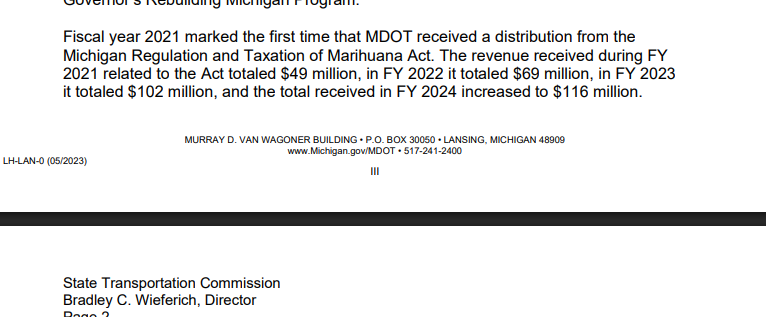
The first time the MTF received funds from cannabis tax revenue was in 2021 which was “only” $49 million – but by 2023 that number had passed $100 million and has steadily grown year-over-year. One option that it seems legislators didn’t even consider was reworking that number, perhaps lowering the amount going to counties and municipalities by 2.5% each.
Doing this wouldn’t significantly impact amounts going from 15% to 12.5% (a difference of $5-7M annually), but it would increase the amount going to the MTF from 35% to 40% (a difference of $20-25M annually) – and it wouldn’t have the potentially devastating effects of inflating the price of cannabis in an already oversaturated market with historically low prices.
In fact, if MiCIA and other opponents to the new tax are right and sales divert to the black market amidst inflation at every turn, that additional tax may not bring in much additional revenue at all. It could end up simply balancing out the lowered amount being allocated from the current tax revenue.
Advocates Raise Awareness of the Risk of Losing Customers to the Black Market
Michigan State Senator Jeff Irwin didn’t mince words, including a statement in the lawsuit calling the tax “a great day for illegal drug dealers and criminal gangs in Michigan.”
His point? High taxes drive people out of the legal, regulated market and straight back to their old connects who don’t charge tax …or test for contaminants.
Adam Hoffer, director of excise tax policy at the Tax Foundation, echoed this concern: “This massive tax increase is really going to hurt the legal market in Michigan. The higher the tax, the greater the incentive for consumers to seek cheaper, unregulated product.”
Michigan’s cannabis market has exploded since recreational legalization kicked in during early 2020. Cannabis stores now pull in close to $300 million in sales monthly — about $3.2 billion in 2024. But with no cap on production or business licenses, the state is drowning in supply, leading to some of the lowest prices in the nation.
That sounds great for consumers, but it’s been devastating for small businesses that are already operating on razor-thin margins. Now add a 24% wholesale tax on top of that – how can anyone imagine this is a sustainable move by any means?
Stuart Carter, founder of the Detroit Cannabis Industry Association, called it “a slap in the face,” saying it was pushed through with little opportunity for public input.
The math is simple: when legal cannabis gets too expensive, people who’ve been buying from the illicit market for decades will just go back to what they know. And those purchases won’t be tested for pesticides, mold, heavy metals, or any of the other contaminants that regulated products are screened for.
Personal and public safety takes a backseat when price becomes the only deciding factor – so shouldn’t it be an obligation for the state to make sure their legal market isn’t pricing out its own customers?
Will MiCIA Successfully Block the Cannabis Tax Increase Before It Goes into Effect in January 2026?
That’s the multi-million dollar question — or, more accurately, the $420 million question (am I the only one who finds it coincidental and funny that they came to 420 as their estimate?).
MiCIA has a solid constitutional argument. The Michigan Constitution is pretty clear about how voter-approved initiatives can be amended, and the legislature’s attempt to sidestep those requirements by creating a “separate” law could backfire spectacularly.
On the other hand, state lawmakers have pulled similar moves before. They wrote new laws to legalize sports betting in 2019 without altering a voter-initiated gaming control law from 1996. So, there’s precedent for creative legislative maneuvering.
The clock is ticking. The state has less than a month to respond to the lawsuit, and the tax is scheduled to take effect January 1st. If MiCIA can’t get an injunction blocking implementation while the case works through the courts, Michigan’s cannabis businesses are going to be dealing with this tax whether it’s ultimately ruled unconstitutional or not.
What happens next could reshape not just Michigan’s cannabis market, but how states across the country approach taxing industries created by voter initiatives.
This one’s far from over and All Things Cannabis will be following the story every step of the way.
Subscribe to All Things Cannabis to follow this story as it unfolds!
Want to support independent journalism, activism, and help All Things Cannabis grow?
Your support makes stories like this possible – check out our Ko-Fi page where you can subscribe for exclusive content, discounts, and freebies. Or visit our shop to grab one of our comfy cannabis themed hoodies or hooded t-shirts to show your support for legalization this fall!